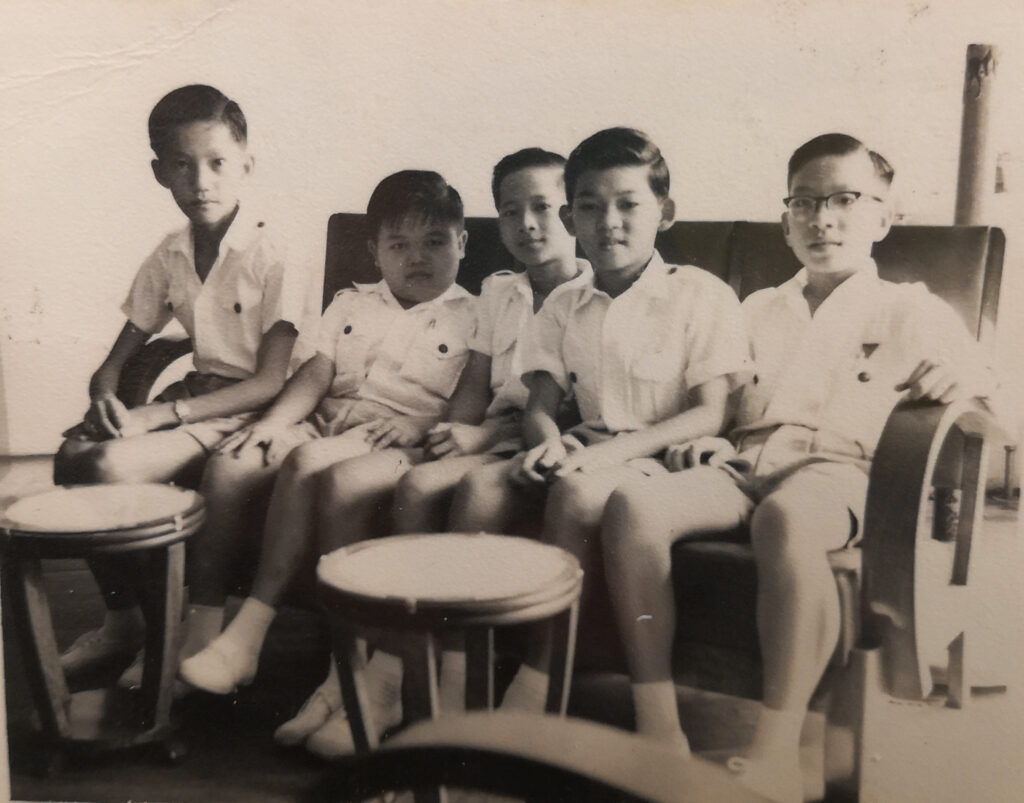
The Foundation Chairperson/Honorary Executive Director of CASS, Mr Henry Pan (known by all as Henry), shared his personal stories to shed light on parenting and children’s education.
Today, Henry shared his experience of learning Chinese while he was in Singapore.
…………………………………………….
When Henry was young and studying in Singapore, both his primary school and high school (Hwa Chong Institution) emphasised teaching the Chinese language. In high school, Chinese classes included learning Classical Chinese, also known as Literary Chinese.
Learning Classical Chinese has enabled Henry to better understand traditional Chinese culture. However, it was challenging to learn this form of classical writing at the beginning, especially when he had never been exposed to these writings during his primary school years.
He remembered when he started high school, the first piece of Classical Chinese text he learnt was “Wei Xue” (The Principles of Learning) written by Peng Duan Shu, a famous scholar of the Qing Dynasty. He had to write a critical review of the article for the assignment. The assignment gave Henry a headache. As he could not fully comprehend the text, he found it difficult to write a critical review that was of a good standard. He did not get a good grade for the assignment, and he felt deeply frustrated.
Henry felt very distressed at the time. To him, the piece of writing seemed something coming from outer space. It sounded odd, and it was difficult to understand. Yet Henry had always been a diligent student. The more difficult it was, the more he was determined to delve into it. He strongly believed that while he was not exceptionally smart, he could conquer anything if he worked hard.
This attitude echoed the content of the piece of classical writing, which said: “Cleverness and acuity, one can rely on it and yet can’t rely on it. If one relies on their cleverness and acuity alone and does not work hard to keep learning, one will ruin their prospects. Fatuity and mediocrity can be both a restriction and yet not a restriction. If one is not limited by their fatuity and mediocrity and makes an effort to learn, one will achieve greatness.”
Henry’s hard work paid off. He gradually understood the content and meaning of the article. He was especially impressed by the following text from the article: “As long as one is willing to learn, even the most difficult things will become easy. If one is unwilling to learn, even the easiest task will become difficult.”
Please stay tuned:
Next week, Henry will share the books and mottos that have influenced his life values.
…………………………………………………
Remarks:
According to Francis Bacon, ‘Histories make men wise’. Classical Chinese is not only a transmission and inheritance of Chinese history but also teaches a lot about life wisdom. There are many benefits for children to learn Classical Chinese.
Like Henry, children may find it difficult at the beginning when studying Classical Chinese. However, after reading the classical texts repeatedly, one will discover that these writings are written beautifully and have a set pattern with rhyming phonics. It often teaches how to solve life problems or expresses sound life philosophies with a few simple phrases.
Learning Classical Chinese during his high school years had enabled Henry to have a high standard of Chinese learning which in turn enabled him to read complicated Chinese classical literature on history. His widespread knowledge through reading greatly influences his life values and philosophy.